
Solution-Focused Therapy (SFT), also called Solution-Focused Brief Therapy (SFBT), is a practical and goal-oriented approach to therapy. This type of solution focused therapy is designed to help a client achieve meaningful life changes by focusing on solutions instead of problems.. This therapy is founded on principles of positive psychology and aims to inspire hope and motivation by highlighting the client’s strengths, resources, and past successes.
Unlike traditional therapies that often explore the origins of a client’s problems, SFBT focuses attention on desired outcomes and the steps needed to reach them. The therapist works with the client to clarify what their life will look like once the issue is resolved. This process helps identify resources and past experiences that can aid in achieving these goals. By exploring “exceptions”—times a client has successfully handled challenges—SFBT helps individuals find actionable solutions for their current circumstances.
With its emphasis on practical, achievable goals, SFBT has become one of the leading schools of brief therapy, influencing fields such as business, education, social policy, and criminal justice. Its approach is not only effective but also concise, making it a popular choice for individuals seeking efficient and positive change.
What is solution-focused brief therapy?
Solution-Focused Brief Therapy (SFBT) has become one of the most widely used therapeutic approaches in the world. Unlike traditional therapies that examine past experiences and behaviors, SFBT focuses on finding immediate solutions and addressing current challenges. This approach is built on the belief that individuals already possess the knowledge and resources to improve their lives, and with proper guidance, they can discover effective solutions.
Developed in the late 1970s by Insoo Kim Berg, Steve de Shazer, and their colleagues, SFBT emerged from a desire for an alternative to traditional psychoanalytic methods. The founders wanted to shift the focus from analyzing the root causes of problems to understanding how to solve them effectively. Their work started informally in Berg’s living room and later led to the establishment of the Milwaukee Brief Family Therapy Center in the early 1980s.
Research on SFBT consistently shows strong evidence of its effectiveness across a wide range of behavioral and psychological issues. A review of 43 studies confirmed its positive impact in helping individuals with diverse challenges.
Notably, SFBT has become very popular in non-Western countries. Since 2013, the volume of research on SFBT in these regions has doubled compared to Western nations. The approach has found particular success in Asia, where Berg was invited to share her techniques in Hong Kong in the 1980s, leading to its spread across Mainland China. Experts believe that solution focused therapy is highly adaptable and effective across different cultures due to its practicality and positive focus

You can overcome mental illness. Reach out to discover:
When is solution-focused brief therapy used?
Solution-Focused Brief Therapy (SFBT) can serve as a primary therapeutic approach or be combined with other treatment methods. It is not limited to a specific demographic but is designed to support individuals of all ages who are facing a wide range of challenges. SFBT has been successfully applied to issues such as child behavioral problems, family conflict, domestic or child abuse, addiction, and relationship difficulties.
While solution focused brief therapy may not directly treat major psychiatric conditions like depression or schizophrenia, it can help people manage and improve their quality of life. By focusing on present challenges and future possibilities, this solution focused therapy helps individuals find practical solutions to everyday problems, which enhances their overall well-being and functioning.
Free Insurance Check
Our rehab center accepts most insurance plans.
Check if your insurance will cover the cost of treatment by filling out our confidential insurance form. We accept most insurance plans.

What to expect from solution-focused brieftherapy?
Goal-setting is central to Solution-Focused Brief Therapy (SFBT). During the first session, a therapist may ask the “miracle question”: “If a miracle happened tonight while you were asleep, what changes would you see in your life tomorrow?” This question encourages you to imagine the changes you want and sets the foundation for your goals. You and your therapist will then break down those goals into small, achievable steps.
A key element of solution focused therapy is the therapist’s positive, respectful, and hopeful attitude. Practitioners believe that people already possess the strength, wisdom, and resilience to make desired changes. What might be considered \”resistance\” in other therapy models is seen in SFBT as a natural protective response. This mindset promotes a collaborative partnership between you and your therapist.
Treatment duration varies, but solution focused brief therapy is often completed in about four to eight sessions. The main focus is on creating practical, short-term changes that can significantly improve your day-to-day life.
WE ARE AVAILABLE 24/7
Request a call for answers and help.
If you or a loved one are struggling with substance use or mental health disorder, request a confidential call now. Our team is ready to guide you through understanding the admissions process, treatment options, costs and more. Taking this step is a sign of strength and the beginning of your path to a healthier future.
"*" indicates required fields
How does solution-focused brief therapy work?
Solution-Focused Brief Therapy (SFBT) operates on the principle that solutions are often found in \”exceptions\”—the times when a problem is absent or managed effectively. Instead of focusing on the problem, SFBT highlights what is already working and helps individuals build on their successes. This solution focused therapy aims to recognize and amplify these exceptions by examining past experiences where clients successfully handled challenges.
In solution focused brief therapy, the therapist uses various techniques such as scaling questions, empathy, and affirmations to help clients identify their inherent strengths.. These tools help clients identify their strengths and resources. This approach encourages clients to see themselves as capable of finding solutions rather than feeling stuck.
For example, if parents are struggling with a child’s behavior, a solution-focused therapist would ask about times when the child behaved well. By focusing on these \”exceptions,\” parents can identify what caused the positive changes. They can then learn to amplify these behaviors and build on their successes. If an approach is not working, SFBT encourages letting go of ineffective methods and trying new solutions.
Are you or a loved one struggling with addiction to alcohol or other drugs? Call today for a confidential conversation with a treatment specialist.
Get the addiction treatment you need here
Realizing you might have a problem with drugs or alcohol is never easy, and asking for help can feel even harder. If you or someone you care about is ready to take that step, our treatment centers can help. Call (888) 899-3880 or use our confidential contact form to reach a recovery specialist. They can help you decide if treatment is needed, explain your options, and work with you on insurance and next steps You can also call SAMHSA’s National Helpline at (888) 899-3880 for information on treatment resources in your area.
Treatment Center Reviews
Bridget LaRocco
I have been to this facility twice now, for Laser Hair removal and Botox. I saw Kim 2 times now for laser and she has been great, she made me feel really comfortable and…
Bridget LaRocco
I have been to this facility twice now, for Laser Hair removal and Botox. I saw Kim 2 times now for laser and she has been great, she made me feel really comfortable and…
Bridget LaRocco
I have been to this facility twice now, for Laser Hair removal and Botox. I saw Kim 2 times now for laser and she has been great, she made me feel really comfortable and…
About the content
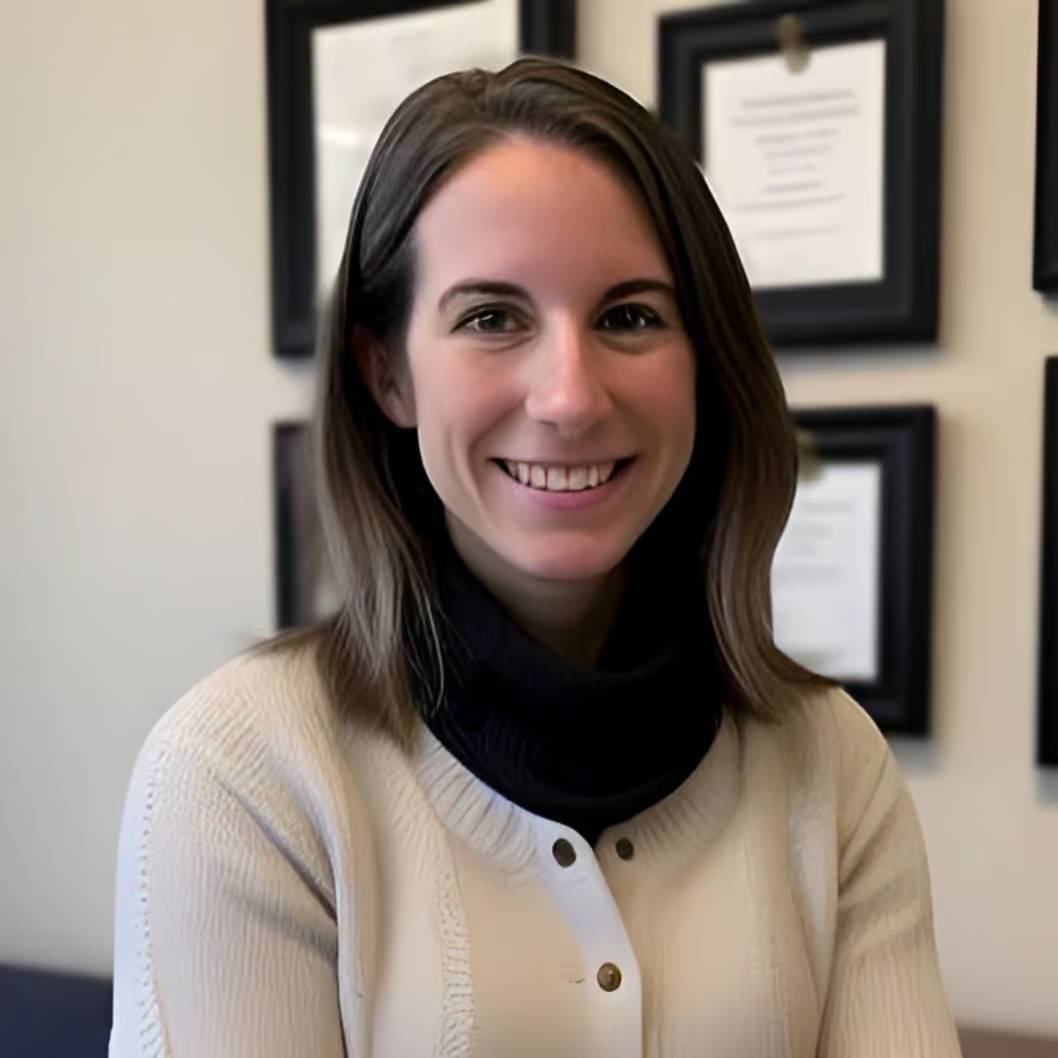
Written by: Carli Simmonds. Carli Simmonds holds a Master of Arts in Community Health Psychology from Northeastern University. From a young age, she witnessed the challenges her community faced with substance abuse, addiction, and mental health challenges, inspiring her dedication to the field.

Medical reviewed by: Jodi Tarantino, LICSW. Jodi is an experienced, licensed Independent Clinical Social Worker (LICSW) and Program Director with over 20 years of experience in Behavioral Healthcare, demonstrating expertise in substance use disorders, mental health disorders, crisis intervention, training development, and program development. She is a skilled leader in business development with a Master of Social Work (MSW) in Community and Administrative Practice from the University of New Hampshire.
Red Ribbon Recovery is committed to delivering transparent, up-to-date, and medically accurate information. All content is carefully written and reviewed by experienced professionals to ensure clarity and reliability. During the editorial and medical review process, our team fact-checks information using reputable sources. Our goal is to create content that is informative, easy to understand and helpful to our visitors.

TREATMENT PROGRAMS
THERAPIES
Check if your insurance will cover the cost of mental health treatment


